
Hotels & extended stay
Guest privacy you can put in writing. Rooms that stop wasting energy the moment they empty.
ALLIE is hotel room occupancy sensing without keycards, door contacts or cameras. mmWave radar in the room's light switch measures whether a guest is present, including a guest asleep, so HVAC and lighting set back the moment a room is truly empty and recover before the guest is back, and housekeeping knows a room is occupied before anyone knocks.
A property gets room-level occupancy that drives energy, sequences housekeeping and shows security which rooms should be empty, with nothing in the room that could see a guest.
The property's problem
Half the day, the room is empty and the building doesn't know it.
Guest rooms sit unoccupied for hours at a time while HVAC and lighting run for nobody. Keycard systems were meant to fix this and guests defeated them on day one. Cameras are out of the question. ALLIE senses real presence from the switch on the wall, and keeps the guest's privacy intact.
By the numbers
The empty room is the most expensive room in the building.
the average hotel room sits unoccupied every day
Source: ENERGY STAR, Energy Savings Tips for Small Businesses: Lodging
of a hotel's electricity goes to heating and cooling
Source: ENERGY STAR, Energy Savings Tips for Small Businesses: Lodging
energy cost reduction from guest-room energy management
Source: ENERGY STAR, Energy Savings Tips for Small Businesses: Lodging
of hotel operating costs are spent on energy
Source: ENERGY STAR, Energy Savings Tips for Small Businesses: Lodging
Use cases
One fixture swap. Eight things a property gains.
Guest-room energy
Setback when the room is truly empty, recovery before the guest returns. Radar sees a sleeping guest that a motion sensor would miss.
No keycard dependency
Nothing to leave in a slot, no second card in a pocket, no door contact guessing. Presence is measured, not inferred.
Set the room from the app
Guests set their room temperature and put the room in Do Not Disturb from the Arqaios app. Housekeeping sees the DND at once, and the room comes back to the guest's setting before they return.
Know before you knock
Housekeeping sees which rooms are occupied right now, so nobody knocks on, or walks in on, a guest who is still in the room.
Housekeeping sequencing
Live occupancy by room lets the floor be cleaned in the order rooms actually empty, with fewer return trips and fewer guest encounters.
A schedule that writes itself
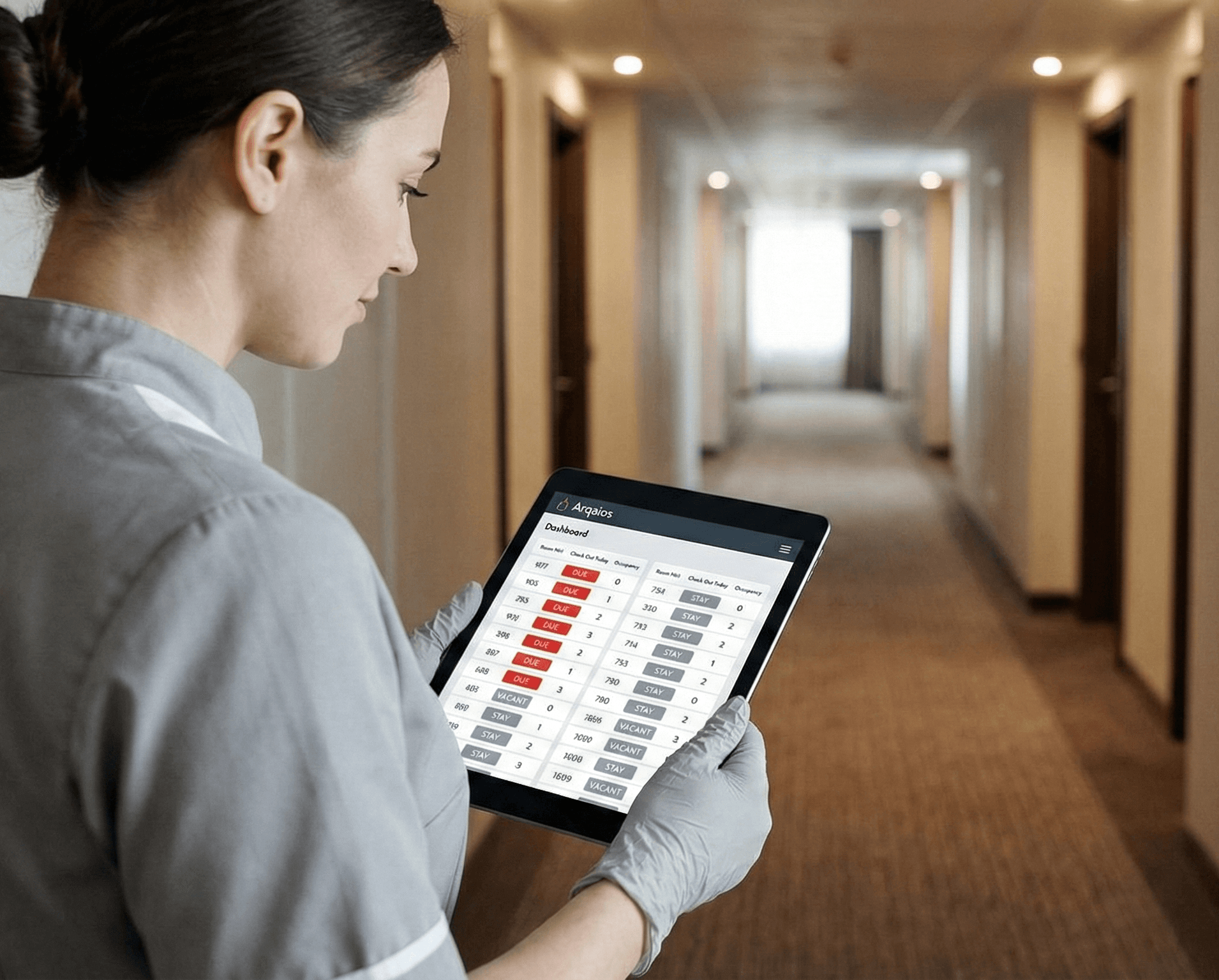
The app builds the day's housekeeping schedule from real-time occupancy and guest checkout times, then re-sequences it as rooms empty, so staff clean rooms that are ready instead of waiting on ones that are not.
Unsold rooms, occupied
Security sees when a room that is not sold or scheduled becomes occupied, so a room that should be empty gets checked.
Back-of-house occupancy
After-hours occupancy in storage, offices and restricted floors is visible to security, with no cameras added anywhere.
Hotel occupancy detection compared
Keycard, motion sensor, door contact or radar.
Every guest-room energy system is only as good as its read on occupancy. This is what each method actually senses, and where it goes wrong.
| Method | What it senses | Where it goes wrong |
|---|---|---|
| Keycard energy-saver switch | Whether a card is in the slot | Any card, or a business card, keeps the room 'occupied' all day |
| Passive infrared motion sensor | Warm objects moving in its line of sight | A sleeping or still guest reads as an empty room; the HVAC shuts off on them |
| Door contact plus timer | Door open and close events | Infers occupancy from the last door event; wrong when two people leave separately |
| ALLIE mmWave radar | People in the room, including Doppler movements that confirm occupancy | Nothing to defeat and nothing to wear; presence is measured directly, with no image |
ENERGY STAR reports that hotel rooms sit unoccupied about 12 hours a day and that guest-room energy management can cut energy costs by 35 to 45 percent. The full picture is on the energy optimization page.
The guest privacy commitment
What you can tell every guest, in one sentence.
“There are no cameras and no audio recording in your room. The room knows whether it is occupied so it can save energy and so housekeeping never walks in on you, nothing more.”
What that sentence rests on
- No image sensor exists in any ALLIE fixture, so there is nothing to disable, cover or audit
- Radar resolves presence and motion, not faces or bodies a person could recognize
- No audio is recorded or streamed; nothing in the room stores sound
- Signals are processed inside the fixture. Occupied or not occupied is the only information the property and Arqaios need for energy optimization, and the only information that leaves the room; there is never a stream
- Guest-facing notices and staff scripts are part of the deployment plan
The best housekeeping visit is the one a guest never notices. ALLIE tells the floor which rooms are empty right now, so the knock on an occupied door stops happening.
Deployment
Fits the renovation cycle. Or a single floor to prove it.
ALLIE fixtures replace the switches, outlets and vents already in the room, so the natural moment is a soft-goods or PIP renovation, but a pilot floor can be swapped during normal maintenance. Occupancy events are designed to integrate with building management and property systems, so HVAC setback, housekeeping status and security's view of the rooms that should be empty all come from the same signal.
Pilot floor
10–30 rooms, before-and-after energy and comfort data.
Integration
Occupancy to HVAC controls and PMS/housekeeping; after-hours and unsold-room occupancy to security.
Guest comms
In-room notice language and staff talking points included.
Portfolio
Room-hours conditioned for nobody, by property, by month.
Questions
Hotel operators ask.
How does hotel room occupancy sensing work with ALLIE?
mmWave radar in the ALLIE light switch measures whether a person is in the room, including a sleeping guest who has not moved. Occupancy drives HVAC setback and recovery, lighting and plug loads, and live occupancy status for housekeeping, so nobody knocks on an occupied door, without keycards, door contacts or cameras.
What can we tell guests about privacy?
That there are no cameras and no audio recording in the room. The room knows whether it is occupied so it can save energy and so housekeeping does not walk in on a guest, and nothing more. Occupied or not occupied is the only information the property and Arqaios need for energy optimization, and the only information the room reports. No image sensor exists in any ALLIE fixture, and guest-facing notices and staff scripts are part of the deployment plan.
How does ALLIE help housekeeping?
Housekeeping sees which rooms are occupied right now, before a knock on the door. The Arqaios app builds the day's housekeeping schedule from real-time occupancy and guest checkout times and re-sequences it as rooms empty, so staff clean rooms that are ready and stop walking in on guests. A Do Not Disturb a guest sets from the app shows on the housekeeping side at once. The same occupancy status is designed to feed the property management system, so a room's state shows up where housekeeping already looks.
Why do traditional hotel occupancy sensors fail with sleeping guests?
Traditional hotel occupancy sensors use Passive Infrared (PIR), which only detects changes in heat across broad movement. When a guest sleeps or sits quietly, PIR registers zero motion, causing the energy management system to falsely assume the room is empty and shut off the air conditioning. 60 GHz mmWave occupancy sensors resolve the small Doppler movements of a guest who is sitting or sleeping, which confirm the room is occupied and keep it comfortable through the night.
What is an occupancy-based hotel energy management system?
An occupancy-based hotel energy management system controls guest-room HVAC, lighting and plug loads based on real-time human presence rather than static schedules or defeatable keycard energy switches. Since hotel rooms sit unoccupied an average of 12 hours a day, fixture-native mmWave radar setback cuts HVAC runtime by 28 to 45 percent without false setbacks or keycard bypass tricks.
How does mmWave occupancy sensing integrate with hotel HVAC control?
mmWave occupancy sensors in the ALLIE light switch communicate directly with guest-room thermostats and building automation systems (BMS/PMS). Upon detecting genuine vacancy, the system initiates an energy setback (adjusting temperature by 3°F to 5°F and cutting phantom standby loads). When the guest returns, high-velocity recovery restores the preferred setpoint instantly.
What does security get from occupancy sensing?
A view of the rooms that should be empty. ALLIE shows when a back-of-house space such as storage, an office or a restricted floor is occupied after hours, and when a room that is not sold or scheduled becomes occupied, so security can check on it. There is no camera and no recording behind either signal.
How is ALLIE installed in an existing property?
It replaces the switches, outlets and vents already in the room, so the natural moment is a soft-goods or PIP renovation, but a pilot floor of 10 to 30 rooms can be swapped during normal maintenance to collect before-and-after energy and comfort data.
Next step
Pick a floor. We'll show you the empty-room hours.
Thirty minutes with your utility bill, your occupancy pattern and your renovation calendar.