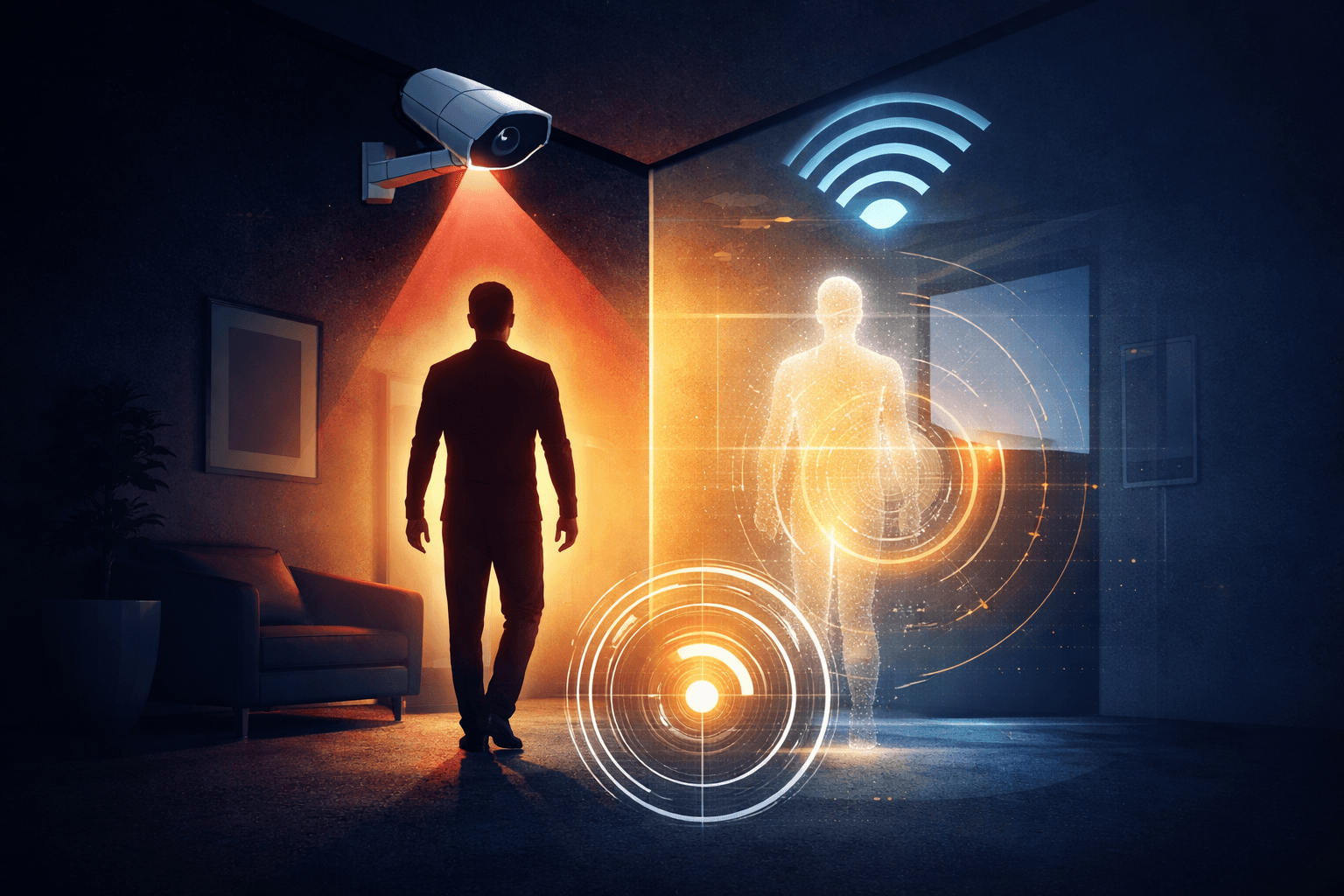
A hotel room is unoccupied for about 12 hours a day on average, and ENERGY STAR reports that guest-room energy management systems can cut a property's energy costs by 35 to 45 percent [1]. The whole premise rests on one input: knowing whether a person is in the room. Four technologies claim to know. They give different answers, and the difference is where the savings, the comfort complaints and the privacy questions come from. This comparison lays out what each method actually senses, with the vendors' own descriptions and the published research. Arqaios makes the radar option; the sources are linked so you can weigh that yourself.
Why occupancy is the whole game
Heating and cooling account for almost 40 percent of a hotel's electricity and lighting for about a quarter, and energy runs about 6 percent of operating costs, roughly $2,196 per available room per year [1] [2]. A guest-room control that sets the thermostat back when the room is empty is the largest single lever, which is why California's building code has required guest-room occupancy controls since the 2013 Title 24 cycle, with the code analysis estimating 12 to 25 percent of annual guest-room HVAC energy saved [3]. Measured results vary with how well the system reads occupancy: a U.S. Department of Energy field demonstration across six hotels in three climates found HVAC savings of 10.8 to 26.5 percent by property, 18.4 percent on average, with paybacks from 5.3 to 15.7 years [4]. Simulations for large hotels put the range at 24 to 58 percent, and found that sensors which count people rather than just detect presence add another 5 to 15 percent [5].
The spread in those numbers is the spread in occupancy accuracy. A system that thinks a room is empty when a guest is asleep shuts off the air on a paying customer; one that thinks a room is occupied because a card is in a slot saves nothing.
The comparison
| Method | What it actually senses | Where it goes wrong | Guest effort | Privacy |
|---|---|---|---|---|
| Keycard energy-saver switch | Whether a card, any card, is in the slot by the door | Any card or a business card keeps the room "occupied" all day; hotels hand out two keys | Guest must insert and remove the card | None sensed |
| Passive infrared (PIR) motion sensor | Changes in infrared heat moving across its field of view, line of sight only | A sleeping or still guest reads as an empty room; the HVAC shuts off on them | None | Motion only |
| Door contact plus timer | Door open and close events, combined with a motion sensor and a timeout | Infers occupancy from the last door event; two people leaving separately, or a guest who never triggers the sensor, confuse it | None | Door events only |
| mmWave radar (ALLIE) | People in the room, including a person lying still and breathing | Coverage is per room, so every room needs a fixture; the switch is already there | None | Presence, position and motion; no image, no identity |
Keycard switches: the workaround is the rule
The keycard energy-saver switch is simple: "as long as the key card remains in the control switch slot, the power remains on" [3]. It is standard in Europe and Asia and was rare in U.S. hotels when Green Lodging News surveyed the market in 2007, which also noted that "about 5 percent of guests will work around the system by leaving an extra key" [6]. Lock vendors say the same thing: ASSA ABLOY Hospitality observed that "guests often leave one key in the slot at all times" [7], and travel writers document that "any card would do the trick" and that some hotels pre-load the slot themselves [8]. Verified-RFID slots close the business-card loophole but not the two-key one. Keycard-based energy management vendors report 25 to 40 percent savings in the rooms where the system is respected [9]; the number in rooms where a card lives in the slot is zero.
PIR motion sensors: the sleeping-guest problem
Passive infrared sensors detect "changes in infrared energy (heat) emitted by an object" and "require a line of sight" [10]. They are cheap, they work, and they cannot see a person who is not moving. Peer-reviewed work on radar occupancy states the limit directly: PIR "cannot sense minute movements like a still, sleeping person" [11], and a second study notes PIR is "not sensitive to small movements (e.g., writing)" while radar can sense "small physiological displacements of the human chest wall" [12]. In a hotel this is the guest asleep at 3 a.m. whose air conditioning switches off because the room "emptied." Schneider Electric's own blog recounts the Los Angeles Times story of guests tying Mylar balloons to the bed so the drifting foil would keep the sensor convinced the room was occupied, and concedes that motion sensors "could disable or setback the room when someone is asleep or in the bathroom" [13] [14]. Lutron's myRoom manual describes the same failure, "your sleeping guest wake up because the thermostat sensor stopped seeing him," and the 15-minute timeout used to soften it [15].
Vendors mitigate in two ways. Verdant's Night Occupancy Mode "turns off the energy management feature during the nighttime" so the system will "never be turned off while your guests are asleep" [16], which protects comfort by giving up the night-time savings. The other approach is the door contact.
Door contacts: inferring presence from the last event
Adding a door switch to a PIR sensor is the industry's standard fix, and it works by inference: the room is considered occupied from the moment the door closes until the sensor has seen no motion for a set period after the last door event. Honeywell's INNCOM logic, for example, will "only go unoccupied after it has seen the room entry door shut" and no motion for the timeout [17]; Telkonet's EcoContact+ keeps the room in an "occupied" status until a subsequent door event [18]; Salto's Universal ESD combines a "passive motion infrared detector and micro door sensor" with a 60-minute motion window and claims 25 to 40 percent savings on heating and cooling [19]. A building-simulation study found that adding a door sensor raised PIR-based occupancy accuracy from 91.5 percent with four PIR sensors to 99.8 percent with one PIR and a door contact [20]. The residual errors are the inference errors: a couple that leaves one at a time, a guest who slips into the bathroom during the timeout, a housekeeper's door event. And the logic still cannot answer the question directly. It reasons about the room; it does not sense the person.
mmWave radar: measuring presence itself
Millimeter-wave radar transmits a low-power radio signal and measures the reflections from the people in the room. Because it resolves motion down to sub-millimeter chest movement, it detects a sleeping guest by their breathing, which is exactly the case PIR misses [11] [12]. There is nothing to leave in a slot and nothing to wave at. Consumer devices have normalized the idea: ecobee's Smart Thermostat Premium lists "Occupancy (Radar)" as a specification [21], and Aqara's FP2 presence sensor "detects presence even if you are not moving" [22]. Infineon describes its 60 GHz sensor as detecting "movements down to sub-millimeter" and doing so "without intruding on privacy" [23], because the output is a point cloud rather than an image.
ALLIE puts that radar inside the room's light switch, with the outlet and the vent as the actuators. The switch measures presence, the vent directs airflow and sets back when the room is empty, and the outlet cuts idle plug loads and restores them on return, so the occupancy read and the energy action live in the same fixtures the room already has. Occupancy and vacancy events are designed to inform the property management system and housekeeping, in the same way today's guest-room systems feed room status to platforms such as Oracle OPERA, Mews and Cloudbeds [24] [25] [26].
The privacy question guests are now asking
Guests have become sensitive to what is in the room. Airbnb banned indoor security cameras in all listings in 2024, "regardless of their location, purpose or prior disclosure" [27], and New York makes it a felony to record in "any room assigned to guests or patrons in a motel, hotel or inn" [28]. Occupancy sensing has to be the kind a front desk can explain in one sentence. A keycard slot senses a card; a PIR sensor senses moving heat; a door contact senses a door; radar senses that a person is there and how they are moving, and cannot produce a picture of them. None of the four records anything. Only one of them knows the guest is asleep.
What to ask a vendor
Ask how the system reads a guest who is asleep, alone and still for eight hours. Ask what happens when two guests leave separately. Ask whether savings claims come from rooms where the sensing was respected or from the whole property, and ask for the DOE field data rather than a brochure figure. And ask what the room could ever reveal about a guest, because that is the question the guest will ask you.
Sources
- ENERGY STAR, Energy Savings Tips for Small Businesses: Lodging.
- ENERGY STAR, Hotels: An Overview of Energy Use and Energy Efficiency Opportunities.
- California Statewide Utility Codes and Standards Program, 2013 CASE Report: Guest Room Occupancy Controls, 2011.
- Pacific Northwest National Laboratory for the U.S. Department of Energy, Guest Room HVAC Occupancy-Based Control Technology Demonstration, 2012.
- Pang Z, et al. Quantifying the energy savings of occupancy-based HVAC control in large hotels. Journal of Building Performance Simulation 2021;14(6).
- Hasek G. Key card energy management systems. Green Lodging News via Hotel News Resource, 2007.
- ASSA ABLOY Hospitality, Guest room energy management. AutomatedBuildings.com, 2012.
- Your Mileage May Vary, Hotel key card power slots, 2025.
- Evolve Guest Controls at the Inn at Penn, Hospitality Net, 2011.
- Lighting Controls Association, A deep dive on occupancy and vacancy sensors, 2026.
- Regev N, Wulich D. Radar-based human occupancy detection. Sensors 2021;21(10):3529.
- Gennarelli G, et al. Radar-based occupancy detection. Frontiers in Signal Processing 2022.
- Schneider Electric, Floating Mylar balloons: the latest technology in hotel comfort?, 2015.
- Schneider Electric, The guestroom energy dilemma, 2015.
- Lutron, myRoom operation and maintenance manual, 2015.
- Verdant (Copeland), Hospitality FAQ.
- Honeywell INNCOM, e7w troubleshooting guide, 2020.
- Telkonet, EcoContact+ datasheet.
- Salto Systems, Universal ESD.
- Kim S, Moon J, Yoon S. Occupancy detection accuracy with PIR and door sensors. Building Simulation 2017.
- ecobee, Smart Thermostat Premium.
- Aqara, Presence Sensor FP2.
- Infineon, BGT60TR13C 60 GHz radar sensor.
- Oracle, Hospitality Integration Platform.
- Mews, Connector API: resources.
- Cloudbeds, postHousekeepingStatus.
- Airbnb, An update on our policy on security cameras, 2024.
- New York Penal Law §250.45.
About Arqaios
Arqaios builds ALLIE, a fixture-native sensing platform that embeds 60 GHz mmWave radar, acoustic sensing and edge AI into standard switches, outlets and vents, for camera-free fall detection in senior living and occupancy-based energy reduction in hotels. Talk to us.