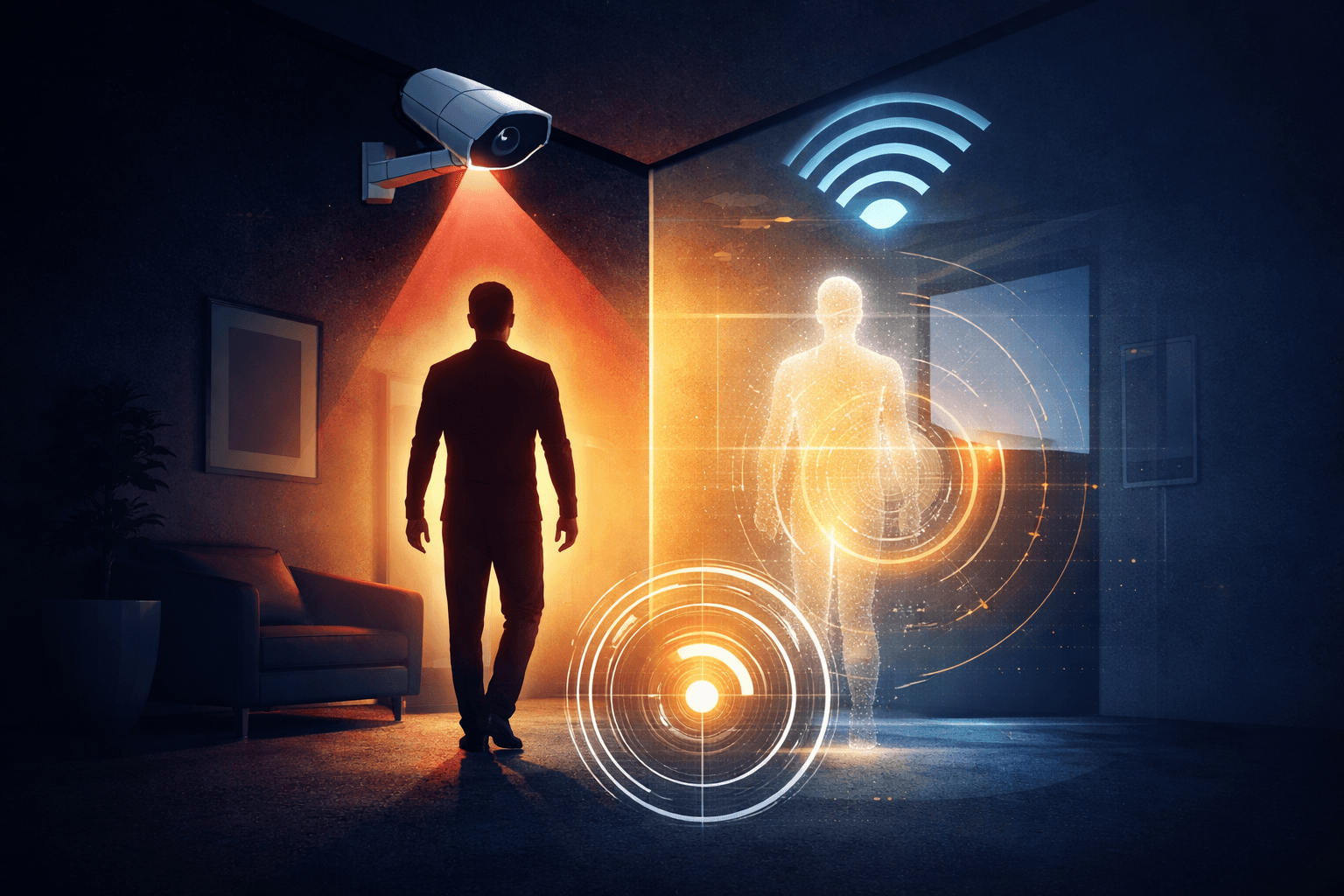
Every senior living operator is choosing between three ways to know that a resident has fallen: something the resident wears, something that watches the room, or something that senses the room without watching it. Each has a real track record now, and each fails in a different place. This is a comparison on the criteria that decide outcomes, with every claim sourced to the vendor's own material or peer-reviewed research. Arqaios builds the radar option, so read the conclusions with that in mind and check the sources yourself.
The problem all three are trying to solve
More than one in four adults over 65 fall each year, and falls caused over 43,000 deaths among older adults in 2024, making them the leading cause of injury death in that group [1]. In senior living the fall itself is only half the danger. The other half is the time on the floor. In the Cambridge City over-75s cohort, 80 percent of people over 90 who fell were unable to get up on their own after at least one fall, 30 percent lay on the floor for an hour or more, and lying on the floor for a long time was strongly associated with serious injury, hospital admission and moves into long-term care [2]. A 1981 study in the same journal found that of older people who lay on the floor for more than an hour after a home fall, half died within six months [3].
So the question for any detection system is not just "can it recognize a fall?" but "does it recognize a fall in a bathroom at 2 a.m., for a resident with dementia, without anyone having to press anything, and does the alert tell staff where to go?"
The comparison
| Criterion | Wearable pendant or watch | Camera-based AI | mmWave radar (ALLIE) |
|---|---|---|---|
| What it senses | Acceleration and (in some) barometric pressure on the body | Images of the room, analyzed by AI | Radio reflections from the body: position, motion, posture, breathing |
| Works if the resident forgets or refuses it | No: nothing worn, nothing detected | Yes | Yes |
| Bathroom and shower coverage | Only if worn in the shower | Legally and socially difficult in private rooms; most vendors avoid bathrooms | Yes; radar senses through steam and in the dark, with no image |
| Night-time and darkness | Yes | Needs infrared illumination | Yes, radar is unaffected by light |
| Long-lie detection when the fall is missed | Depends on the resident pressing the button | Yes, if the camera covers the spot | Yes, the person on the floor is still sensed |
| Privacy in the room | Good: nothing in the room | The central objection; regulated by state law in resident rooms | Good: no image exists; events, not recordings, leave the room |
| What the alert contains | "Fall detected" (or the button) with a location if paired to a locator | Location plus a video clip for review | Room and zone, severity and post-fall status |
| Resident acceptance | Stigma, false alarms and remembering to wear it are the documented barriers | Privacy is the dominant barrier, especially bedrooms and bathrooms | Nothing to wear, nothing pointed at anyone |
| Install | Per resident, ongoing charging and replacement | Devices mounted in each room, wired or Wi-Fi, plus a hub | Replaces the switch, outlet and vent already in the room |
Wearables: reliable only when worn and pressed
Personal emergency response pendants still do most of the work in assisted living, and their limits are documented by the people who sell them. Lifeline states that its AutoAlert fall detection "does not detect 100% of falls" and that users should always press their button when they need help [4]. Medical Guardian says fall detection "must be worn around the neck to allow for adequate detection of falls" [5]. Bay Alarm Medical puts it plainly: "There's no such thing as a 100% accurate auto fall detection system" [6]. Apple's support page for Apple Watch fall detection says the watch "cannot detect all falls" and may trigger on high-impact activity that is not a fall [7].
The bigger problem is not sensitivity but use. In the BMJ cohort, 70 percent of people living alone had a call alarm, yet in 80 percent of falls that happened alone the person did not use it to summon help [2]. An umbrella review in BMC Public Health puts it as "up to 4/5 older adults wearing PERS did not activate it to call for assistance when they had a fall" [8]. Automatic detection was supposed to fix this, but real-world results have been thin: a University of Washington deployment of a wearable fall detector with 18 older adults over up to four months recorded 84 false alarms and one true fall [9]. A 2021 survey of 626 caregivers found that only 28 percent of care recipients used a fall-alert wearable at all [10]. In memory care the picture is harder still. A 2026 scoping review of care-home residents, families and staff found that unfamiliar or conspicuous wearables lowered acceptance even where adherence was otherwise high, and that passive devices were seen as more suitable for people with cognitive impairment [11]. A separate 2026 review of fall-detection technologies states the obvious constraint in one line: "a device that is not worn cannot detect a fall" [12].
None of this makes pendants useless. For a resident who wears one and can press it, the button is the fastest path to help. It is the residents who cannot or will not who need something else, and they are the residents at highest risk.
Cameras: the best evidence, and the biggest objection
Camera-based systems have produced the strongest published outcome data in memory care. SafelyYou installs cameras in the bedrooms of residents who have opted in, stores video only when a fall is detected, and has remote nurses review each event [13]. A 2019 study in the American Journal of Managed Care compared a memory-care facility using real-time video fall detection with a control group: 35.4 percent of falls in the control group led to an EMT visit and 24.5 percent to an emergency department visit, against 15.7 percent and 8.3 percent in the intervention group [14]. That is a serious result and operators should know it.
The objection is equally serious. A 2025 scoping review of 50 studies on older adults' acceptance of camera-based assisted-living technology found privacy to be the dominant barrier, most acutely in bedrooms and bathrooms; identity-redacting filters increased acceptance, which is why newer systems render residents as stick figures or blurred shapes [15]. Inspiren's AUGi, for example, states that residents "appear as stick figures" and that the device never displays or stores clear images [16]; Teton describes a ceiling sensor whose raw visual data "never leaves the resident's room" [17]. Those are real mitigations, but they mitigate a camera. The lens is still there, and so is the law: Illinois's Authorized Electronic Monitoring in Long-Term Care Facilities Act requires the resident's written consent, the written consent of any roommate, signage at the door and, unless otherwise arranged, the resident pays for the equipment [18]; Texas and Minnesota have comparable statutes, and one tally counts 18 states with resident-camera laws [19]. Bathrooms, where the BMJ cohort's long lies happened, are generally outside what any operator will point a camera at.
Radar: sensing the room without an image
Millimeter-wave radar transmits a low-power radio signal and measures the reflections from everything in the room. The output is a point cloud, a set of points with positions and velocities, not a picture; a person is a cluster of points with no face, skin or clothing. That is why radar can be placed where a camera cannot: it detects the person on the bathroom floor and cannot produce an image of them.
Vayyar Care, the most widely deployed radar fall sensor, describes "radar-based monitoring" that "eliminates the need for cameras, maintaining privacy at all times," mounted on a wall or ceiling with coverage of about 16 square meters per device [20]. Helpany markets ceiling-mounted "radar-based motion monitoring" with "no cameras, no microphones" [21], and Essence's MDsense is a ceiling or wall radar fall detector that "does not require the resident to wear any detection device" [22]. The peer-reviewed accuracy figures are in the same range as the other modalities: a 2026 review in Applied Sciences reports 90 to 99.8 percent for radar and RF systems, 79.6 to 99.98 percent for vision and 90.3 to 99.9 percent for wearables, with the caveat that 98.5 percent of the studies used simulated falls [12]. A 2026 study in Scientific Reports using a 60 GHz sensor reported 97.9 percent accuracy across multi-person scenarios [23], and a 2020 review notes that RF sensing "can work under low light conditions and occlusions" where cameras cannot [24].
Radar's limits are also worth stating. It is line-of-sight within a room, so coverage is per room, not per building, and stand-alone radar sensors are one more device to mount and power in every room. That is the reason Arqaios put the radar inside the light switch, and paired it with acoustic sensing that recognizes the sound signature of an impact or a call for help in the fixture: the switch, outlet and vent are already in every room, they are already powered, and together they cover the room from wall to ceiling without a single new device on the wall.
What the alert says
The last criterion is the one staff feel every shift. A pendant press says "help" and, with a locating system, where. A camera system sends a clip that someone reviews. ALLIE sends the room and the zone, a severity read from the impact signature and time on the floor, and post-fall status: did the resident get up, are they moving, is breathing and motion normal. If nobody acknowledges the alert, no-response timers escalate to the next tier automatically. That is the difference between a buzzer and an answer to the three questions a night nurse asks before walking: where, how bad, and are they up.
The honest summary
Wearables are inexpensive and familiar, and they fail exactly where the risk is highest: residents who forget, refuse or cannot press. Cameras have the best outcome data and the strongest objection, and they stay out of bathrooms. Radar covers the room without an image, at accuracy comparable to both, and the remaining question is how it gets into every room. Fixture-native sensing is Arqaios' answer to that question. Whatever you choose, ask the vendor for real-world, unanticipated-fall data rather than lab figures, and ask what the first alert message contains.
Sources
- Centers for Disease Control and Prevention, Older Adult Falls: Facts About Falls and About Older Adult Falls, reviewed September 2026.
- Fleming J, Brayne C. Inability to get up after falling, subsequent time on floor, and summoning help: prospective cohort study in people over 90. BMJ 2008;337:a2227.
- Wild D, Nayak US, Isaacs B. How dangerous are falls in old people at home? BMJ 1981;282:266-268.
- Lifeline, Medical alert systems with fall detection.
- Medical Guardian, Frequently asked questions.
- Bay Alarm Medical, Automatic fall detection.
- Apple Support, Use Fall Detection with Apple Watch.
- Warrington DJ, Shortis EJ, Whittaker PJ. Are wearable devices effective for preventing and detecting falls: an umbrella review. BMC Public Health 2021.
- Chaudhuri S. Real-world accuracy of a wearable fall detector deployed with older adults. University of Washington, 2015.
- Vollmer Dahlke D, et al. Family caregivers' perspectives on wearable fall-alert devices. JMIR Aging 2021.
- Swain-Velasco A, et al. Perceptions of care home residents, families and staff about wearable devices: a scoping review. European Geriatric Medicine 2026.
- Ishaq M, Guastella DC, Sutera G, Muscato G. Fall detection technologies for older adults: a review. Applied Sciences 2026;16(4):1929.
- SafelyYou, SafelyYou Safety AI and fact sheet.
- Xiong GL, et al. Real-time video detection of falls in dementia care facility and reduced emergency care. American Journal of Managed Care 2019;25(7).
- Tham NAQ, Brady A-M, Ziefle M, Dinsmore J. Barriers and facilitators to older adults' acceptance of camera-based active and assisted living technologies: a scoping review. Innovation in Aging 2025;9(2).
- Inspiren, AUGi.
- Teton, How Teton protects resident privacy.
- Illinois General Assembly, Authorized Electronic Monitoring in Long-Term Care Facilities Act, 210 ILCS 32.
- Texas Health and Safety Code §242.847; Minnesota Statutes §144.6502; state tally at recordinglaw.com.
- Vayyar, How Vayyar Care works.
- Helpany, Radar-based fall prevention.
- Essence SmartCare, MDsense fall detector.
- Chen et al. Millimeter-wave technology for multi-person fall detection validated through wearable sensors and real-life scenarios. Scientific Reports 2026.
- Wang X, Ellul J, Azzopardi G. Elderly fall detection systems: a literature survey. Frontiers in Robotics and AI 2020;7:71.
About Arqaios
Arqaios builds ALLIE, a fixture-native sensing platform that embeds 60 GHz mmWave radar, acoustic sensing and edge AI into standard switches, outlets and vents, for camera-free fall detection in senior living and occupancy-based energy reduction in hotels. Talk to us.