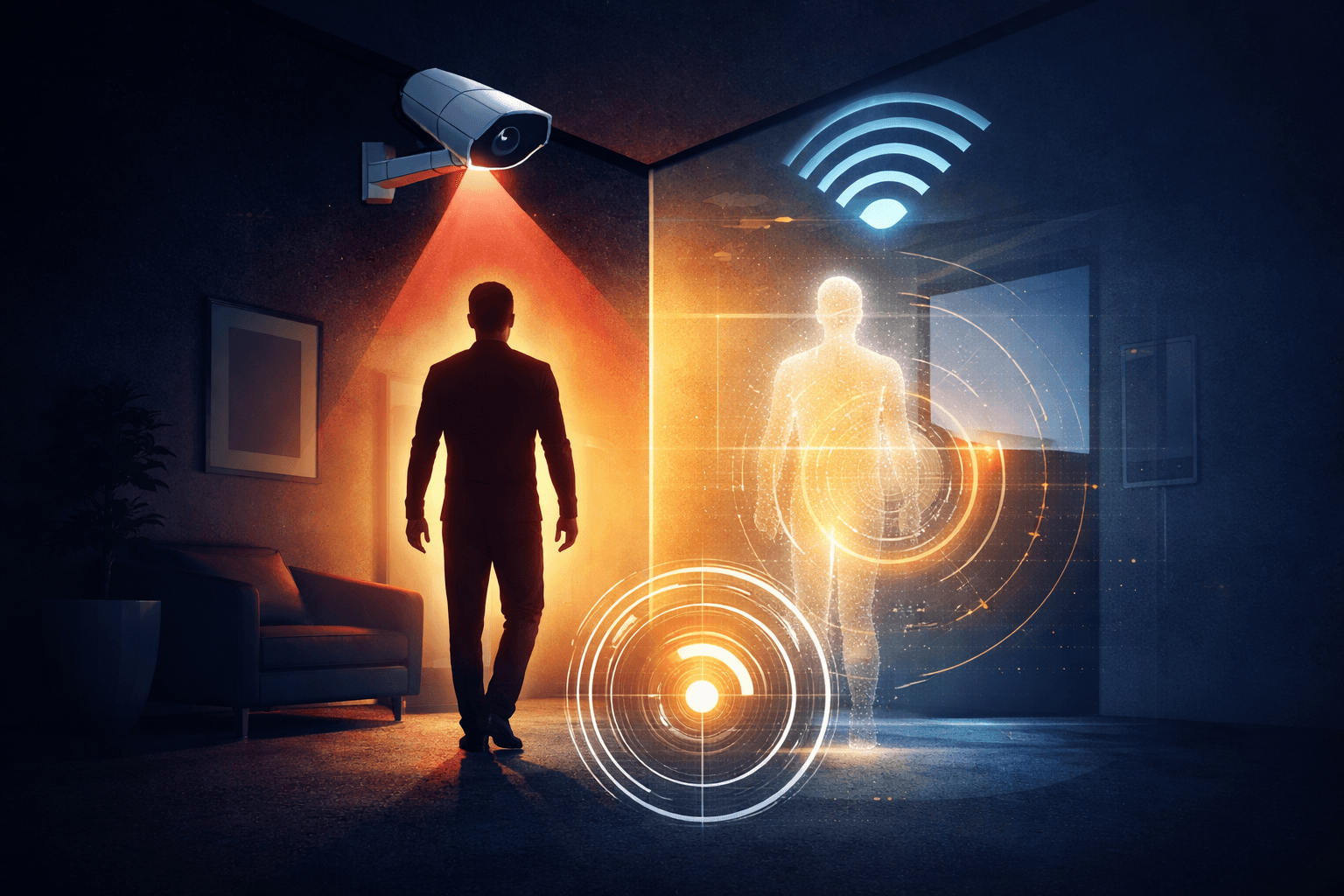
In August 2026 Comcast rolled out WiFi Motion to millions of Xfinity gateways: an opt-in feature that watches for changes in the Wi-Fi signals between the router and stationary devices and logs motion in the home [1]. It joined Linksys Aware, launched in 2019 on Origin Wireless technology [2], Plume's Sense [3], and the WiFi Motion software Cognitive Systems had already placed with 37 service providers by 2021 [4]. IEEE published the 802.11bf WLAN sensing amendment in September 2025, so sensing is now a standard Wi-Fi capability rather than a vendor trick [5].
Arqaios uses a different radio for a different reason: 60 GHz millimeter-wave radar built into a light switch. Both technologies sense people without a camera, and marketing on both sides leans on that. But "no camera" is where the resemblance ends. The two differ in what they can infer about a person, how far they reach, and what happens when someone else gets hold of the signal. Those differences decide which one belongs in a bedroom, a bathroom or a hotel room.
How each one works
Wi-Fi sensing measures how a Wi-Fi signal is disturbed on its way between two devices: as a person moves through the room, the channel state information (CSI) the receiver records changes, and software reads motion from those changes. Comcast's version detects motion "based on the amount of signal disruption" between the gateway and selected devices [1]. The signal is a communications signal, occupying 20 to 160 MHz of bandwidth at 2.4 or 5 GHz, and it was designed to pass through walls, because that is what a home network needs.
Millimeter-wave radar is a sensing signal. A 60 GHz radar chip such as the Texas Instruments IWR6843 sweeps 4 GHz of bandwidth [6], and range resolution follows directly from bandwidth: TI's own primer gives the formula and works it out, "a chirp bandwidth of 4GHz translates to a range resolution 3.75cm," with motion sensitivity down to "a fraction of a millimeter" [7]. The output is a point cloud: for each reflection, a range, an angle, a velocity and a signal strength [8]. A person appears as a cluster of moving points. There is no lens and no image; as Google's Soli team put it for the 60 GHz radar in Pixel 4, "no distinguishable images of a person's body or face are generated or used" [9].
The comparison
| Wi-Fi sensing | 60 GHz mmWave radar | |
|---|---|---|
| Signal | Communications signal at 2.4 or 5 GHz, 20 to 160 MHz wide | Dedicated sensing signal at 57 to 64 GHz, up to 4 GHz wide |
| Spatial resolution | Coarse; infers motion from signal disturbance | A few centimeters; resolves position, posture and breathing |
| Reaches through walls | Yes, by design | Barely: plasterboard alone attenuates 60 GHz by 12 to 32 dB |
| Where it senses | Wherever the network reaches, including neighbors' rooms | The room the fixture is in |
| Who can read the signal | Anyone within radio range who can sniff the traffic, in published attacks | The radar that transmitted it |
| Identifies individuals | Demonstrated at near-100 percent in research | Distinguishes people by gait in research; produces no image or biometric |
| Regulation | Unlicensed Wi-Fi bands | FCC Part 15.255 field-disturbance rules with strict power limits |
What Wi-Fi sensing has been shown to infer
The reason to take Wi-Fi sensing seriously as a privacy question is a decade of published research, none of it hypothetical.
In 2015, researchers at Michigan State recognized keystrokes from the CSI of an ordinary TP-Link router, "96.4% recognition accuracy for classifying single keys" and 93.5 percent on continuous sentences [10]. In 2014, a Hong Kong team read lips from Wi-Fi reflections with an average accuracy of 91 percent for a single speaker on a small vocabulary [11]. In 2020, a University of Chicago and UC Santa Barbara team showed that an attacker outside a building, passively sniffing the existing Wi-Fi traffic of ordinary IoT devices, could detect and track occupants' movements inside using a receiver costing under $20 [12]. In 2023, Carnegie Mellon reconstructed dense human body pose, 24 body regions, using two commodity routers as the only input [13]. And in 2025, researchers at the Karlsruhe Institute of Technology showed that the beamforming feedback Wi-Fi devices exchange in the clear can identify individuals: with 197 participants they reached almost 100 percent accuracy, passively, with the target carrying no device at all [14]. "This technology turns every router into a potential means for surveillance," the lead author said [14]. A separate 2025 study, WhoFi, re-identified people from CSI with a 95.5 percent rank-1 score [15].
Two properties of Wi-Fi make these results possible. The signal goes through walls, so the sensing does too. And it is a broadcast that anyone in range can receive; the sensing does not require cooperation from the network's owner. Comcast's terms add a third: the company says it "may disclose information generated by your Wi-Fi Motion" to third parties in legal proceedings, and motion history is stored in its cloud for seven days [1] [16].
What mmWave radar can and cannot do
Radar's resolution is higher, so it might seem the more intrusive of the two. The physics says otherwise on the questions that matter in a private room.
It stays in the room. At 60 GHz, a plasterboard wall attenuates the signal by 12 to 32 dB and a wooden door by 26 to 41 dB, according to NIST measurements [17]; an IEEE 802.15 study found a gypsum wall costs about 10 dB at 5 to 6 GHz but 33 dB or more at 60 GHz, with transmission dropping "dramatically above about 8-12 GHz" [18]. Origin Wireless, which sells Wi-Fi sensing, makes the same point from the other side: "Radar technology is line-of-sight, meaning it can't see through walls" [19]. For a network that is a limitation. For a bedroom it is the feature: the fixture senses the room it is in and nothing next door.
It cannot produce an image. The radar resolves where a person is, how they are moving and their posture, and can read breathing from chest motion, which is how Google's Nest Hub tracks sleep without a camera [20]. What it does not resolve is a face, skin, clothing or text. IEEE Spectrum's description of Vayyar's imaging radar is exact: it sees people "but it can't identify them as individuals" [21]. A 2024 comparison paper notes that radar and Wi-Fi sensors alike "do not capture biometric information" in the sense a camera does [22]; the difference is that radar keeps its signal and its inference inside one device.
It is a closed loop. The radar transmits and receives its own signal; there is no broadcast to sniff and no third-party device in the path. What leaves an ALLIE fixture is an event, "occupied" or "fall detected," produced by AI running in the fixture.
It is regulated as a sensor. Consumer 60 GHz radars operate under FCC Part 15.255, which caps peak radiated power at 14 dBm for field-disturbance sensors in the 57 to 64 GHz band [23], far below the general-population exposure limit of 1 mW per square centimeter that applies from 1.5 to 100 GHz [24]; ICNIRP's 2020 guidelines set the equivalent reference level at 10 watts per square meter for the public [25].
Which one is better at the job
Set privacy aside for a moment and ask which signal actually senses a person more accurately. A 2024 IEEE radar conference paper ran the same neural network on both: "Radar achieves a classification accuracy of 97.78%, while Wi-Fi achieves only 65.09%," with the Wi-Fi phase data "containing noise due to synchronization issues" [22]. A 2026 study that compared ceiling-mounted FMCW radar, UWB radar and Wi-Fi radar for in-bedroom activity and sleep-interruption monitoring across 20 participants and six room layouts found the radars generalized best to unseen rooms and attributed the gap to "range resolution, antenna diversity, Doppler resolution" [26]. The same bandwidth that gives radar its resolution gives it its accuracy.
The case for radar in a bedroom, stated plainly
Wi-Fi sensing is cheap, already installed, and reaches everywhere the network does. Those are exactly the properties that make it wrong for the rooms where people are most vulnerable: it senses through walls, it can be read by others, and it has been shown to identify people, read keystrokes and reconstruct bodies from a signal nobody thought of as a sensor. Radar at 60 GHz is confined to its room, produces no image, keeps its inference in the device, and is more accurate at the one thing a safety system has to get right. That is why ALLIE senses with radar in the light switch and not with the Wi-Fi that is already in the walls.
Sources
- Xfinity, WiFi Motion support article and Comcast, Xfinity Shield announcement, August 2026.
- Origin Wireless, Linksys Aware launch, 2019.
- Plume, Plume Sense datasheet.
- Wi-Fi NOW, 37 service providers deploy Cognitive's WiFi Motion, 2021.
- IEEE Standards Association, IEEE 802.11bf-2025.
- Texas Instruments, IWR6843 single-chip 60 to 64 GHz mmWave sensor.
- Iovescu C, Rao S. The fundamentals of millimeter wave radar sensors. Texas Instruments, 2020.
- Texas Instruments, People counting and tracking reference design using mmWave radar.
- Google Research, Soli radar-based perception and interaction in Pixel 4, 2020.
- Ali K, Liu AX, Wang W, Shahzad M. Keystroke recognition using WiFi signals. MobiCom 2015.
- Wang G, Zou Y, Zhou Z, Wu K, Ni LM. We can hear you with Wi-Fi! MobiCom 2014.
- Zhu Y, et al. Et Tu Alexa? When commodity WiFi devices turn into adversarial motion sensors. NDSS 2020; University of Chicago summary.
- Geng J, Huang D, De la Torre F. DensePose from WiFi. arXiv 2023.
- Karlsruhe Institute of Technology, The spy who came in from the Wi-Fi, 2025 (Todt J, Morsbach F, Strufe T, ACM CCS 2025).
- Avola D, et al. WhoFi: deep person re-identification via Wi-Fi channel signal encoding. arXiv 2025.
- TechCrunch, Comcast adds motion sensing to millions of its newer routers, with a privacy catch, August 2026.
- NIST, Penetration loss at 60 GHz for indoor-to-indoor and outdoor-to-indoor mobile scenarios, 2020.
- Siwiak K. Through-wall propagation up to the 60 GHz band. IEEE 802.15 contribution, 2006.
- Origin Wireless, WiFi sensing vs. radar: coverage, cost, and connectedness, 2022.
- Google Research, Contactless sleep sensing in Nest Hub, 2021.
- IEEE Spectrum, Vayyar's 72-transceiver radar chip sees just enough, but not too much, 2018.
- Dahal S, Biswas S, Gurbuz AC, Gurbuz SZ. Comparison between Wi-Fi-CSI and radar-based human activity recognition. IEEE RadarConf 2024.
- eCFR, 47 CFR §15.255, Operation within the band 57-71 GHz.
- Cornell Law School LII, 47 CFR §1.1310, Radiofrequency radiation exposure limits.
- ICNIRP, Guidelines for limiting exposure to electromagnetic fields (100 kHz to 300 GHz). Health Physics 2020.
- Lambrecht S, et al. A comparison between ceiling-mounted FMCW, IR-UWB and Wi-Fi radar for in-bedroom human activity monitoring and sleep interruption detection. arXiv 2026.
About Arqaios
Arqaios builds ALLIE, a fixture-native sensing platform that embeds 60 GHz mmWave radar, acoustic sensing and edge AI into standard switches, outlets and vents, for camera-free fall detection in senior living and occupancy-based energy reduction in hotels. Talk to us.